Fourth Year Pharm.D. Students Apply Classroom Learning During Medical Brigade in Honduras
LAWRENCE — University of Kansas School of Pharmacy students Mary Fritz and Josiah Kelley spent a week in February 2026 applying their training far from the classroom, participating in a medical brigade in rural Honduras that challenged them to deliver patient care in a resource‑limited setting.
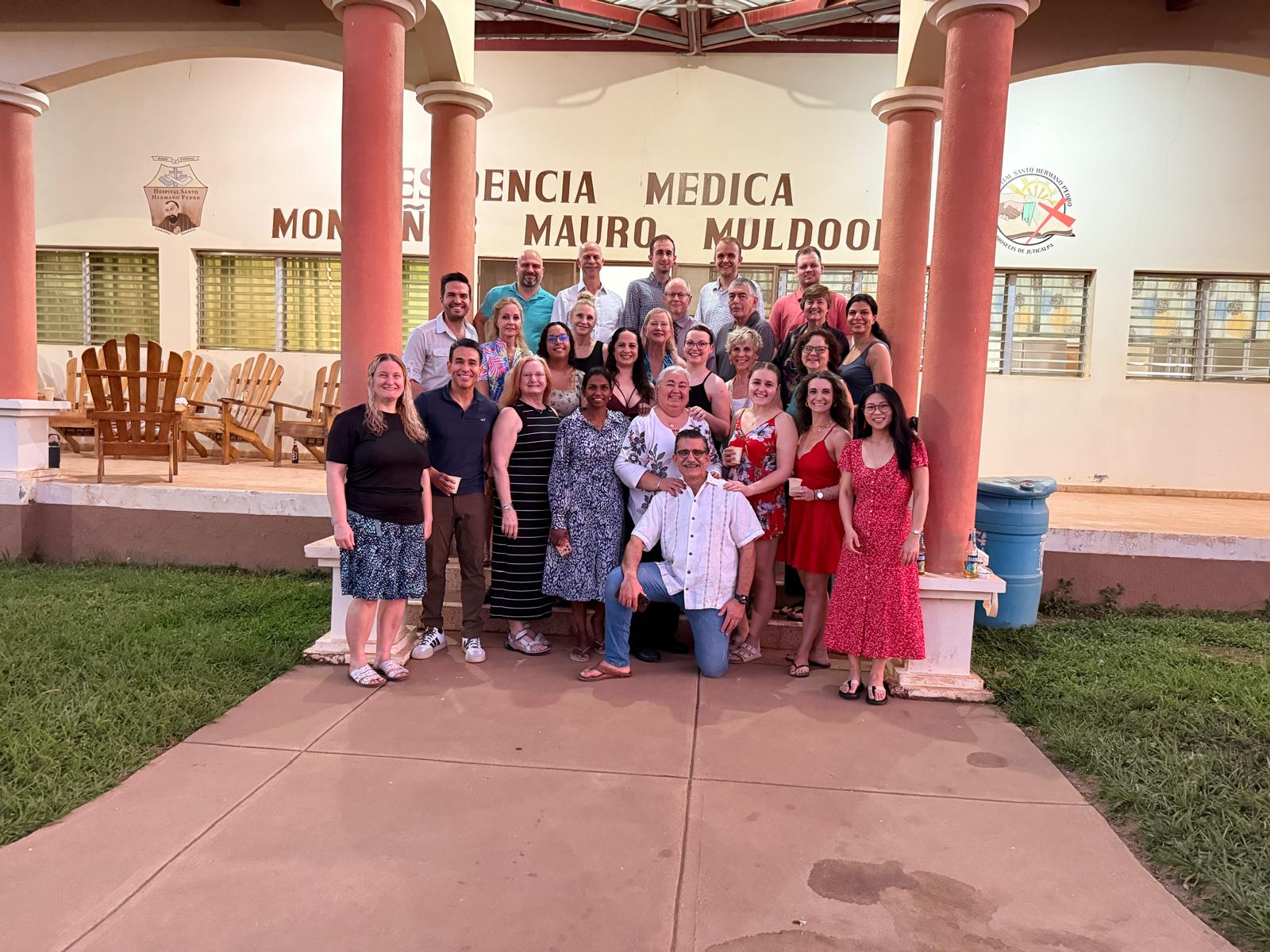
The weeklong brigade, held in Catacamas, Honduras, brought together students and health care providers from multiple disciplines to offer free medical services to underserved communities. Over six days, the team served nearly 1,400 patients, many of whom traveled long distances for care.
The brigade is led by Dr. Mario Castro, MD, MPH, a pulmonologist at the University of Kansas Medical Center (KU Med), whose decades‑long partnership with the local hospital has allowed KU teams to return year after year. His leadership reflects the university’s One KU initiative, which emphasizes collaboration across KU health sciences programs to address complex health challenges through shared expertise and service.
The team included Dr. Castro, four residents and a nurse from KU Med, along with physicians from Saint Louis University, Cox Health in Springfield, Missouri, Children’s Mercy, and several other health systems. Dr. Castro began the medical brigade while working in St. Louis and continued his involvement after joining KU.
Different Paths, Shared Purpose
Fritz, a Kansas native from Manhattan, said she was immediately drawn to the opportunity after learning about the brigade during a pharmacy school seminar. Her interest in community‑focused care and serving underserved populations made the trip a natural fit.

“As pharmacists, we’re incredibly accessible in the U.S.,” Fritz said. “Being able to take the knowledge we’ve been given at KU and provide it to people who don’t have the same access, and to do that directly, was really important to me.”
Kelley, who grew up in Albuquerque, New Mexico, said his motivation stemmed from both cultural connection and curiosity about practicing pharmacy outside traditional settings. Having studied Spanish from a young age, he viewed the brigade as a rare opportunity to practice health care in a different cultural and clinical context.
“This was such a unique placement; not a hospital, not ambulatory care,” Kelley said. “It was a chance to practice pharmacy in a very different environment and really learn how medicine works in another setting.”
Preparation for the brigade began months before students arrived in Honduras. Fritz and Kelley coordinated medication ordering, managed donated supplies and prepared a temporary pharmacy to support specialty teams in pulmonology, cardiology, gastroenterology, neurology and surgery.
Fritz said the scale of the 2026 brigade, the largest to date, required careful planning and adaptability.
“We didn’t know exactly what we would see until we got there,” she said. “You had to be prepared to work long days, see a lot of patients and problem‑solve constantly.”
Kelley said keeping expectations flexible was key.
“I tried to temper my expectations so I could adapt to whatever situation came up,” he said. “That mindset helped a lot once we were actually practicing there.”
Practicing Pharmacy in a Resource‑Limited Setting
Once on the ground, students quickly encountered the realities of resource‑limited health care. Many patients presented with respiratory disease, allergies and chronic conditions exacerbated by environmental factors such as dirt roads and cooking over open fires.
Fritz frequently worked with patients on inhaler education and allergy management, noting how visibly exhausted many were from years of unmanaged symptoms.
“You could see it in their faces,” she said. “When patients took a breath after treatment and said, ‘Is this how breathing is supposed to feel?’, that sticks with you.”
Kelley described working closely with providers to adapt treatment plans when medications ran out or were unavailable.
“There were moments where we had to say, ‘We had this yesterday, but we’re out today,’” he said. “That meant collaborating in real time to find affordable, realistic options for patients.”
Sustainability and Perspective
Both students said the brigade reshaped how they think about continuity of care and sustainability in global health.
Kelley noted that returning to the same hospital each year helped bridge gaps often associated with short‑term missions.
“There were patients coming back year after year,” he said. “That continuity is rare, and it made you think more carefully about what treatments made sense long‑term.”
Fritz said the experience sharpened her focus on patient education, a skill she now carries into her everyday practice.
“Patients don’t care about pharmacokinetics,” she said. “They want to know how a medication will make them feel and whether it will [actually] help. That’s something I’m much more intentional about now.”
Carrying the Experience Forward
Both Fritz and Kelley said the brigade reaffirmed their commitment to community pharmacy and service‑oriented practice.
Kelley, who will begin working at a Dillons pharmacy in Junction City, said the experience strengthened his desire to work in diverse communities.
“I love that community pharmacy keeps you on your feet,” he said. “You never know what’s coming next, and now I feel even more prepared for that.”
For Fritz, the trip reinforced why experiential learning opportunities are critical for pharmacy students.
“These experiences remind you why you chose this profession,” she said. “You step outside of yourself, apply what you’ve learned and come back a better pharmacist, and a better listener.”